The mission of the Honors Program is to help students become inquisitive thinkers
who possess the skills necessary to ask profound questions, to recognize and respect
diverse perspectives, to solve complex problems, and to express their vision creatively
and persuasively to others. Honors courses emphasize inquiry, interdisciplinary problem
solving, and the effective expression of ideas. The program culminates in the honors
thesis, a year-long research, service, or creative project on a question or problem
chosen by the student. Every graduate of the Honors Program will have demonstrated
the ability to work independently in their chosen field.
The Honors Program brings together a very special group of students – highly motivated,
intellectually curious, and eager to talk about what they’re learning. You’ll have
plenty of stimulation in talking with your fellow Honors students, both in class and
after class. The Honors Program also sponsors events throughout the academic year,
when you’ll go far afield and broaden your cultural horizons together.
First-year honors students can become even more immersed in the honors community because
they are eligible to live in the Honors Living Learning Community, where they have
their own floor in one of our on-campus residences. Long talks into the night, help
with homework just a few steps away, and shared trips and activities are just some
of what you can look forward to.
Apply for the Honors Program
To learn more, please contact Myles Allan, Assistant Director of Enrollment Communications
at MAllan@newhaven.edu
Honors Courses
Students will join in researching, writing, and producing the podcast “Crime Waves.”
The work is focused on Henry C. Lee faculty, who have led some of the world’s top
investigations, as well as prominent external guest speakers. Students will be responsible
for researching two one-hour episodes. This work would consist of conducting preliminary
interviews with the guests, professionally producing the podcast episode, packaging
it, and promoting it. The Crime Waves podcast interviews people at the center of the
biggest investigations in the world: prosecutors, criminals, professors, corruptors,
journalists, undercover investigators, policemen, Olympic Gold Medalists, and mobsters
— all experts with first-hand knowledge of the criminal world.
The first rule about Book Club is that you talk about Book Club. In this course, up
to 18 faculty members each choose a book they love; students then select three of
these reading groups to join. Each group is limited to three to five students to keep
discussion intense, free-flowing, and fun. A final project helps students reflect
on what they have learned during the course.
Through diffractive reading of literary, philosophical, and neuroscientific texts,
students will examine the concept of self and how this concept is shaped (both materially
and metaphorically) through intra-action with external agents. Consideration of the
ethical impact of self-formation will further guide exploration. This critical foundation
will develop into creative “design” of the future versions of self, with emphasis
on the increase of agential power in environments (social and professional) students
envision as important.
This course challenges students to critically examine games as interactive worlds
to enable the creation of their own creative works. Over the course of the semester,
students will study the cultural theories of gameplay, critique several games in depth,
and discuss techniques of storytelling and world building in the medium. Students
will implement these ideas in building a series of games — including board games,
interactive text-based games, and video games. Students will work individually and
in groups to create their games. They will take advantage of the resources of the
new Schaub Makerspace to fabricate materials for board games and design digital games
using tools such as Twine, Bitsy, GB Studio, and Unity3D.
This course offers a unique opportunity for students to unravel the intricate knots
that bind music and identity. Through the careful study and analysis of popular music,
we will explore the evolving historical, cultural, and social factors that both reflect
and shape our understanding of gender and sexuality. From the cabaret and blues of
the 1920s to the hyperpop of the 2020s, we will examine representations of queerness
and feminism across the dynamic landscape of popular music, including discussions
on activism, empowerment, equality, and backlash. Coursework will include creating
a collaborative website to collect relevant student examples, critical analyses, and
reflections.
Climate change has been defined as one of society’s greatest threats. These threats
include extreme weather events, sea level rise, melting sea ice, ocean acidification,
the intensification of hurricanes, and loss of biodiversity. An introduction to how
the climate system works, oceanographic processes, and how these factors affect our
society, economy, and policies will be discussed. Vulnerability research, behavior
change theories, and both national and international policies to address these changes
will be covered. This course will take a multidisciplinary approach to address these
relevant and applicable issues.
Administrative evil has been and remains a central feature of public and private organizations
in the modern era. In this course, we will explore notions of masked and unmasked
evil and consider how the conditions of technical rationality, with its emphasis on
the scientific-analytic mindset and the belief in technological progress, provide
the conditions for the emergence of administrative evil. The foundations of our study
will consider how ordinary people fulfilling ordinary organizational roles assisted
in and supported unprecedented destruction in ways that were packaged as socially
normal and appropriate. Topics will include the Holocaust, the abuse of detainees
at Abu Ghraib prison, and the Flint, Michigan water crisis. Finally, we will consider
ways in which administrative evil can be unmasked and potentially expatiated.
This course explores the intersection of socioeconomic status and human health. By
examining biological and sociological differences throughout the life course, students
will explore topics such as the impact of poverty on expecting mothers, the predictive
power of being born in a specific zip code on social and health outcomes, what gender
is—biologically speaking— and how/why that matters in society, and biological and
sociological predictors of illness and end-of-life outcomes. The course will place
special emphasis on dispelling myths and understanding the facts and statistics surrounding
these important issues, encouraging students to critically analyze the information
presented.
We make introductions more exciting. The Honors Program routinely offers Honors sections
of introductory core courses, such as General Chemistry, Thinking Historically, Introduction
to Criminal Justice, Personal Finance, and Bioethics.
Honors Thesis
The University of New Haven has an enviable reputation as a leader in the field of
experiential education, and the Honors Program contributes significantly to that reputation.
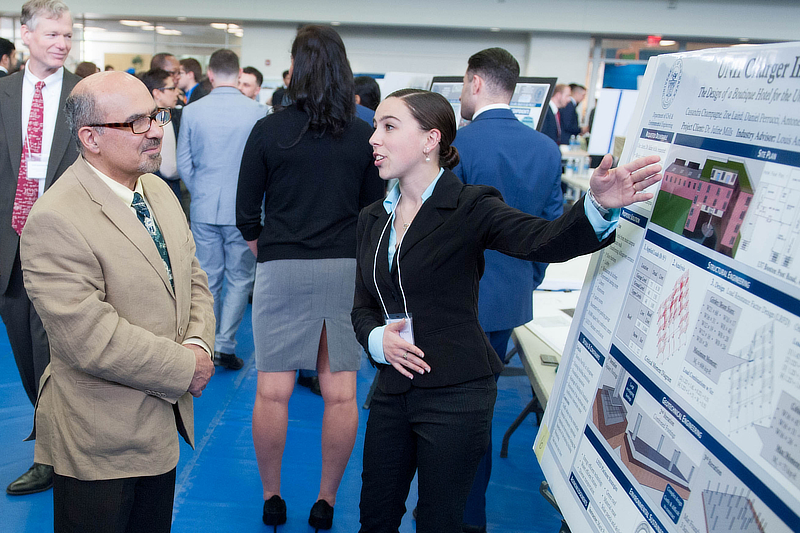
The Program has established a long tradition of undergraduate research, with seniors
required to complete an honors thesis by undertaking an in-depth project on a topic
in their major/minor disciplines. The project is designed, researched, and written
under the guidance of a faculty advisor. The finished theses are then bound and proudly
displayed in the Marvin K. Peterson Library.
While the thought of doing a thesis may seem daunting at first, honors students have
plenty of support to help them along in the process. The below three courses (each
are 1 credit) are specifically geared to the research and writing of your thesis and
will de-mystify how to go about it, provide feedback on how your work-in-progress
is shaping up, and accompany you in the homestretch:
As interesting and stimulating as your honors classes will be, there’s a time to leave
the four walls of the classroom behind and go out and have fun. Of course, even fun
can be instructive, as our special Honors Program activities demonstrate. But it’s
the kind of instruction you won’t need to work at — it’s just absorbed with the good
time you’re having.
There’s always something new in the way of activities, but these are the ones you
can count on every year:
Shakespeare In the Park.A picnic, a blanket, your fellow honors students, and The Bard all come together in
New Haven’s Edgerton Park in star-spangled nights to remember.
Film Series.Our mix of classics, little-known indie films, and crowd pleasers always delights
lovers of the Big Screen. A little talk before each film and more than a little pizza
make for a great time at the movies.
New Haven Symphony.Thrill to the sound of a full orchestra in all its power every February — “great performances
month” on our activities calendar.
What value has the Honors program brought to your experience as a student? The Honors Program was a valuable experience because it gave me the opportunity to
meet with my peers in many different environments, and also to approach classes in
an interesting, more unique way. Being able to live and communicate with students
in the program in the Honors ELC was a very beneficial experience, as I was able to
interact with my peers on a daily basis who were going through the same structured
program. As a result, I built many long-lasting relationships with my peers that have
continued to this day.
How has the Honors program helped you post-grad? The best benefit that I obtain as a recently graduated student is that my research
experience gained through the Honors Thesis will substantially aid me in career searching
and development. Being able to say that I created and conducted my own research in
a biology lab is a great quality to employers that will serve me well.
What unique skills has your participation in the Honors program equipped you with? (Research, communication, etc.) The most unique experience I acquired as an Honors Student is through the Honors Thesis,
as my research in a biology lab gave me exposure to techniques and protocols that
are beyond the classroom. I learned many methods that greatly improved my knowledge
of the biological world and provided me with experience that will continue to be applied
in my future.
What was your favorite Honors course and why? My favorite Honors course was a special topics course about climate change in the
ocean and how we, as a society, react to it. It was a very conversational course that
allowed me, and my peers from the Honors program, to share thoughts about how we perceive
our own climate. I particularly enjoyed this course due to its uniqueness and emphasis
on talking with one another about our viewpoints.
The Honors Program was a valuable experience because it gave me the opportunity to
meet with my peers in many different environments.
SARAH MIDDLETON
National Security B.S., Spring 2024
What value has the Honors program brought to your experience as a student? The Honors program has enhanced my experience because it forced me to take classes
outside of my immediate interests. It helped me to expand my interests and push me
outside of my comfort zone. The thesis preparation classes also helped prepare me
for work I had to complete in other non-Honors courses.
How has the Honors program helped you post-grad? The Honors program has helped me post-grad because it has provided me with the crucial
verbal and written communication skills I’ll need in the world of national security.
It has also made me more confident in my research abilities.
What unique skills has your participation in the Honors program equipped you with?
(Research, communication, etc.) The Honors program has made me a better researcher, writer, and communicator. The
Honors thesis specifically helped me to foster these skills, and I can now produce
much better pieces of writing.
What was your favorite Honors course and why? The Code-it was by far the most interesting Honors class I’ve taken, and the professor
was the best I’ve ever had at the university. It was not a course I would have chosen
on my own had it not been an Honors class, but it was one of the best I ended up taking
in my four years here.
The Honors program has made me a better researcher, writer, and communicator.
HANNAH PROVIDENCE '22
Economics B.S., Minor in Professional & Technical Writing, Spring 2022
Joining the Honors Program at the University of New Haven created an ideal situation
for me. Not only did I receive an academic scholarship to help pay down my tuition,
but I also was directly exposed to a community of fellow students and professors.
So, even though I was new on campus, I instantly had people I could connect and build
relationships with.
One of the experiences that had the most impact on me was becoming President of the
Honors Student Council. This leadership role taught me a lot of important soft skills
that I now use in my career, and I am grateful to have had the opportunity. In addition,
some of my favorite courses were offered through the program. I truly believe that
joining the Honors Program enriched my educational experience as an undergraduate!
Joining the Honors Program at the University of New Haven created an ideal situation
for me.
Students with exceptional academic qualifications will receive an application to the
Honors Program after their admission to the university. Additionally, students may
request an application to the program by contacting Myles Allan, Assistant Director
of Enrollment Communications, atMAllan@newhaven.eduor the Honors Program athonors@newhaven.edu.
In addition, students who achieve a minimum GPA of 3.3 in their first semester at
the University of New Haven may apply to the Honors Program. Transfer students who
have 32 credit hours or less may also apply, provided they have a minimum GPA of 3.5
from their previous institution.
To graduate as an Honors Scholar, students must complete the following:
HNRS 1112 "Seminar in Academic Inquiry and Writing" (3 credits)
HNRS 4459 "Developing an Honors Thesis Proposal" (1 credit)
Four other honors courses of the student’s choice, two of which must 2000-level or
above (at least 12 credits)
The honors thesis (3 credits)
Maintain a 3.3 cumulative GPA
Scholarships
Every student who is selected to participate in the Honors Program will receive an
annual $1,000 scholarship in addition to any other merit-based awards received. In
their sophomore and junior years, honors students may also apply for one of six prestigious
Hatfield Scholar Awards, which are granted on the basis of academic excellence, campus
involvement, and community service. Hatfield scholars receive an additional $3,000
scholarship and a bronze medallion at graduation.
Honors Program Enhanced Learning Community
The Honors ELC is open to a small number of incoming first-year honors students. Residents
in the ELC live in one of the University's on-campus residences and benefit from a
rich array of activities and programs. All residents of the Honors Program ELC will
have the opportunity to participate in special events. In the past, residents of the
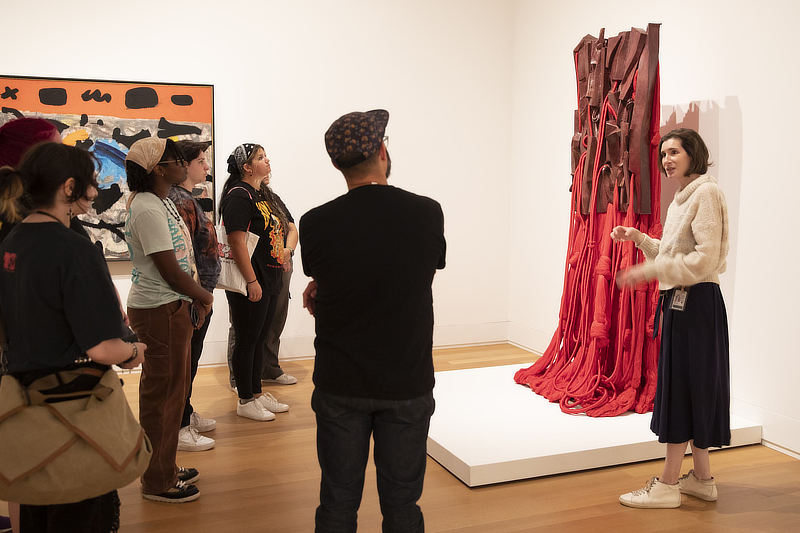
ELC have toured museums in downtown New Haven, gotten lost in the corn maze at Lyman
Orchards, hiked up Sleeping Giant, visited the Museum of Tolerance in New York, and
seen the musicalPeter and the Starcatcheron Broadway.