
Sustainability Research
Advisor:
Byungik Chang, Professor of Civil Engineering
Undergraduate Student:
Jongsung Lee
Sponsor:
Provost Assistantship
Project Description:
Compared to the national average residential retail electricity price, Connecticut
(CT) had the 4th highest electricity price in the country with 19.23 cents/kWh in
September 2015, nearly 50% higher than the national average for price of electricity.
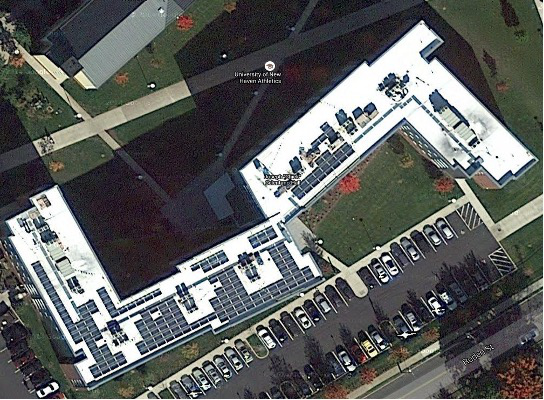
This study aims to assess the economic feasibility of the solar PV systems at the
campus under realistic constraints, by analyzing actual data from the solar array
on campus. The project focused on the economic feasibility of solar PV systems on
campus with physical, spatial, and practical constraints that result in a project
to deviate from theoretical (estimated) values. To achieve that, the prediction of
the PV power generation from the building was developed and compared with the actual
(measured) data.
Status:
Completed
Dissemination:
https://doi.org/10.1016/j.jweia.2020.104130
Advisor:
Byungik Chang, Professor of Civil Engineering
Graduate Student:
Sai Pujitha Karanam
Sponsor:
University Research Scholar
Project Description:
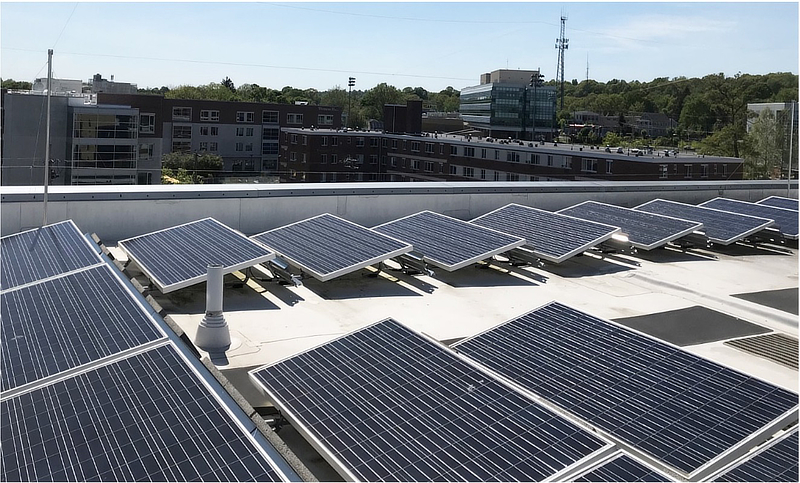
The primary objective of the study was to analyze the economic feasibility of solar
photovoltaic systems (PV) in higher education institutions in CT. To perform the objective,
several economic parameters were calculated and the annual electricity revenue for
the University of New Haven was determined and applied to the entire state of Connecticut.
The study was expanded to other states in the U.S. by normalizing the available roof
area, electricity rate and solar index by each state. The total electricity generation
was estimated for various regions by normalization. This estimation can be used by
university administration for calculation of total power generation and total revenue
per year in that particular state. With the normalization ratio obtained, one can
identify the total power generation in other regions of the U.S. beforehand while
considering installation of PV systems. A Life cycle analysis was performed at the
end to determine how beneficial it is to adopt solar PV in the long run.
Status:
Completed
Dissemination:
International Journal of Green Energy:
https://doi.org/10.1080/15435075.2022.2075703
Advisor:
Byungik Chang, Professor of Civil Engineering
Graduate Student:
Muhammad Rauf Shaker
Sponsor:
University Research Scholar
Project Description:
The present impediments to the implementation of sustainable practices in residential
and commercial structures in the United States, India and Afghanistan will be evaluated
and compared in this study. This study intends to identify the barriers to sustainable
development within the residential and commercial buildings creating a basis for the
methods to address these issues. The selection of these three countries was based
on taking the United States as a developed country, India as developing country and
Afghanistan as an undeveloped country. Understanding the barriers studied will establish
a path to overcoming them and allow the market to open up to the widespread implementation
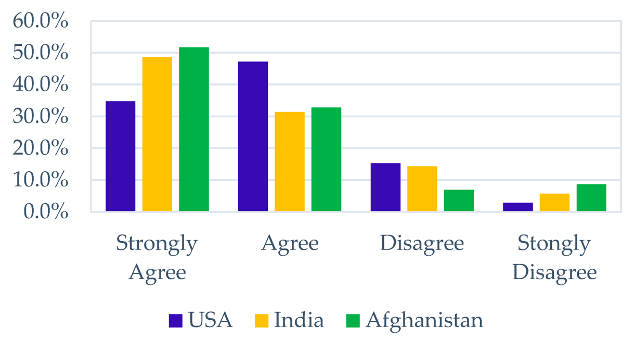
of sustainable practices. According to the survey conducted, about 91% of respondents
in Afghanistan, about 71% in India and 32% of respondents in the USA have moderate
to low knowledge on sustainable construction. Other barriers mentioned in the study
include the high cost of materials, insufficient training, government policy, and
so on.
Status:
Completed
Dissemination:
Sustainability
https://doi.org/10.3390/su142416830